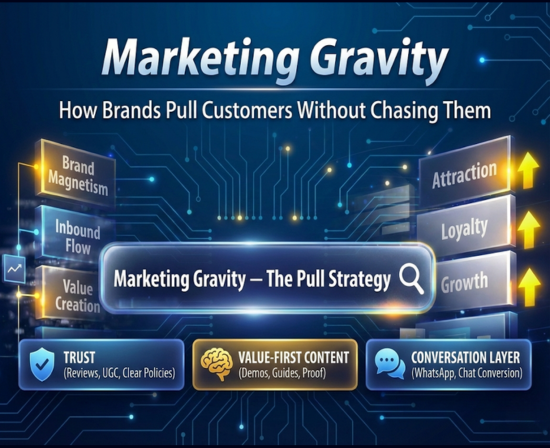
Marketing Gravity: How Brands Pull Customers Without Chasing Them
Hi All, Let me start with a scene you’ve must have experienced:
You put your brand out there.
You increase visibility.
You highlight offers.
People notice, engage and move on.
If that sounds familiar to you, you don’t have a “content problem.”
You have a gravity problem.
In 2026, the brands that win in Indian ecommerce won’t be the most promotional.
They’ll be the ones that feel reliable — the ones customers trust, remember, and come back to.
So let’s talk about Marketing Gravity:
The ability of a brand to pull demand instead of chasing it.
Quick check (reply in your head or comments):
Are you currently chasing customers… or pulling customers?
1) Why chasing customers often pushes them away
Chasing looks like:
- Constant discounts
- Daily “buy now” content
- Desperate DMs
- Changing offers every week
- Talking about your product more than their problem
Because when every message sounds like a closing line, shoppers do the only logical thing: they delay decisions.
Try this mini-audit (be honest):
If a customer sees 3 posts from you today, will they learn something… or only see selling?
If it’s mostly selling, you’re training your audience to scroll past you.
2) How trust creates inbound demand (quietly, over time)
Here’s what changed:
Attention is expensive, but trust compounds.
Edelman’s 2025 brand trust report shows 80% of people trust the brands they use, and the report frames trust as a major purchase factor — not a “nice to have.”
That’s the core of Marketing Gravity:
When trust goes up, persuasion goes down.
What’s the one trust signal you’re missing right now?
- Reviews?
- UGC?
- COD confidence?
- Clear returns?
- Visible delivery time?
Pick one. Build it this week.
Real brand signal: Nykaa (trust at scale)
Nykaa’s growth is a good example of trust turning into repeat demand.
Reuters reported strong performance driven by premium beauty demand and expansion, including 265 beauty outlets and improving margins alongside growth.
You don’t need Nykaa’s scale.
You need their principle: make trust easy to feel.
3) Why familiar brands feel like the safer choice
In India, “safe choice” is a conversion lever.
Nielsen has repeatedly found that recommendations from people you know and online reviews are among the most trusted forms of advertising in India.
Translation?
If your brand doesn’t feel familiar, shoppers won’t feel confident.
If I hide your logo, will your content still feel recognizable?
If not, your brand is getting views…
but not building memory.
4) How value-first content creates brand pull
Value-first content doesn’t mean “educational for the sake of it.”
It means:
- Removing confusion
- Answering objections before they’re asked
- Helping buyers choose correctly
- Making the decision feel simple
And in India, YouTube is becoming a serious “trust engine” for this.
Google’s India update (Oct 2025) shared that in just one year:
- 40%+ of eligible creators joined YouTube Shopping Affiliate in India
- 3M+ videos were tagged with affiliate products
That’s not just a creator update.
That’s a buyer-behavior signal:
People want to buy, but they want proof first.
Turn your product into 3 content formats:
- “Is it worth it or not?”
- “Best under ₹____”
- “If you’re buying ___, avoid this mistake”
5) The shift from selling messages to magnetic pull (the 2026 funnel change)
Here’s a practical 2026 reality that most brands still haven’t adapted to:
Meta Shops now use website checkout (as of September 2025).
So Instagram/Facebook is becoming:
- Discovery
- Product tagging
- Retargeting
…but your site + chat becomes the conversion machine.
When someone clicks your Reel today, where do they land?
- A) Home page
B) Collection page
C) Product page
D) WhatsApp chat
If it’s A, you’re leaking conversions.
Because Marketing Gravity is not just content — it’s the path after the content.
6) The moment customers start coming back on their own
This is the “gravity moment”:
When customers don’t need convincing…
they just need a reminder.
In India, that reminder often happens on WhatsApp.
Case study: Tata CLiQ (WhatsApp)
WhatsApp Business published a success story reporting:
- $500,000 in sales in one month attributed to WhatsApp
- 10x ROI vs email / push / SMS
- 57% clickthrough rate
Notice what’s happening here:
WhatsApp isn’t “support.”
It’s confidence + conversion + repeat.
If a buyer has one small doubt (size, delivery, authenticity)…
do they have an instant place to ask it?
If not, you’re forcing doubt to sit in silence.
Silence kills sales.
7) Why strong brands don’t need to convince — only remind
Convincing sounds like:
- “Trust us”
- “Best quality”
- “Limited time”
Reminding sounds like:
- “Here’s the proof”
- “Here’s what you get”
- “Here’s delivery + returns”
- “Here’s what customers said”
Case study: Tanishq (Click-to-WhatsApp)
A Click-to-WhatsApp campaign case study reported:
- ₹4.1 Cr revenue
- ~9k unique leads
- 14x+ ROAS
Again — don’t copy the category.
Copy the mechanism:
Ad → Chat → clarity → store/checkout → purchase
Your 2026 Marketing Gravity Checklist (save this)
If you want customers to come to you more often in 2026, build these:
1) Proof (trust assets)
- Reviews + UGC
- Clear returns / COD
- Delivery timelines
- Comparison posts (vs cheaper alternatives)
2) Value-first content (pull content)
- Objections answered
- “Best under ₹____”
- Demos + use cases
- “Choose the right one” guides
3) Conversation layer (confidence)
WhatsApp isn’t optional in India.
It’s your conversion advantage.
One question to close (and I want you to answer it)
If you had to improve only ONE thing this month to build Marketing Gravity, what would it be?
A) Stronger content (value-first)
B) Stronger proof (reviews / UGC / trust)
C) Stronger chat conversion (WhatsApp flows)
Written by
Webcooks Technologies
Webcooks Team