THE REAL REASON BRANDS DON’T SCALE Why Saying “No” Has Become a Critical Strategy
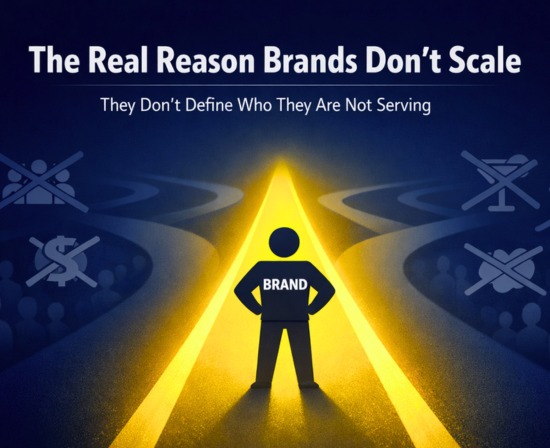
It took Nike almost two decades to truly scale — not because the product was weak, but because the brand didn’t know who it was really built for. In the early years, Nike attempted to sell to everyone, and like most brands that chase the “general public,” they blended into the noise. The turning point came when they finally owned their identity: that they wanted to sell their shoes only to athletes and for the sports world — not for casual buyers. The moment Nike stopped trying to please everybody and started speaking directly to a specific group of people , the brand went global.
And therein lies the truth most brands choose to ignore: you don't scale by increasing your audience; you scale by sharpening your identity, i.e., by targeting a specific niche
Why Saying “No” Has Become a Critical Strategy
Let’s start with a story.
Two college friends launched a new home decor brand—classy and aesthetic products, stylish photos and videos, and strong ads. In the beginning, for the first few months, traffic surged on their website, but conversions didn’t follow. The team assumed that the solution was simple to reach more people.
So they expanded the audience. Broader ads. More demographics. More interests.
And the result? The numbers got worse.
It wasn't until they clearly defined who they were NOT serving-bargain hunters, last-minute buyers, or those who want mass-manufactured items-that things started to change.
They repositioned themselves for people who value curated design, artisanal quality, and premium aesthetics. In just three months, their conversions had tripled without increasing the ad spend due to targeting their correct niche.
The shift didn’t come from flashier content, new media buying techniques, or fancy automation.
It came from clarity — the kind that only appears when a brand stops being afraid of saying “no.”
The Silent Damage of Trying to Serve Everyone
On the surface, serving everyone looks like a growth mindset, but it is actually the complete opposite of it. It actually creates a mess, and a company can’t even serve a single set of audiences, let alone its targeted audience, efficiently and effectively.
When a brand tries to appeal to all kinds of audiences:
- The message doesn’t reach the right audience
- Product value feels inconsistent
- Content loses personality
- Marketing decisions become chaotic
- Ideal buyers feel disconnected
It’s like you are trying to speak in ten different languages at once in a conversation — you end up speaking none fluently.
Most brands don’t realise how expensive this mistake is.
This is where digital marketing often gets blamed:
“Ads aren’t working.”
“Leads aren’t quality.”
“People aren’t resonating.”
But the problem isn’t the marketing.
It’s the lack of identity.
When your brand tries to welcome everyone, it simultaneously convinces your real audience that you aren’t specifically for them.
Clarity Creates Gravity — Not Audience Volume
What makes people stop scrolling?
What makes someone read a caption?
What makes a stranger press “Buy Now”?
It’s not scale.
It’s not reached.
It’s not frequency.
Its relevance comes from identity clarity.
Brands that grow rapidly online don’t attract the most people.
They attract the right people so strongly that those people start spreading the word for them.
This is the invisible power of clarity
It doesn’t just attract — it pulls.
And that gravitational pull is what gives a brand authority, differentiation, and long-term momentum in digital marketing.
The Wrong Audience Costs More Than Ads
Here’s something agencies know but rarely say out loud:
The wrong audience is more expensive than a high CPC.
Misfit buyers will:
- Click but never convert
- Ask questions, but do not purchase
- Add to cart, but do not check out
- Drain ad budgets
- Lower relevance scores
- Confuse your analytics
When a brand doesn’t define who it shouldn’t serve, it ends up attracting people who would never have bought in the first place.
That’s why saying “no” is not about exclusion — it’s about efficiency.
Positioning Works Only When You Choose Who You Refuse to Serve
Imagine two cafés.
One says, “We serve everyone.”
The other says: “We serve people who want great coffee, quiet ambience, and a mindful experience.”
Which one feels more premium?
Which one earns more loyalty?
Which one justifies better pricing?
Brands become powerful when they stop trying to fit into every category and instead carve out their own.
This is true whether you’re a product brand, a service provider, or even a digital marketing agency — positioning is not about adding more; it’s about choosing less.
Specificity Builds Leadership. Broad Targeting Builds Noise.
Broad targeting, broad messaging, broad audiences — they create traffic, yes.
But traffic is not traction.
Specificity, on the other hand:
- Sharpens your brand voice
- Deepens emotional connection
- Increases conversion rates
- Builds community loyalty
- Elevates brand value
Category leaders don’t rise because they target everyone.
They rise because they target someone so precisely that the brand becomes irreplaceable to that segment.
Exclusion Strategy: Why Rejecting Low-Intent Segments Creates Demand
Counterintuitive, but true:
Sometimes, the fastest way to grow is to make your audience smaller deliberately.
When you eliminate:
- Price-sensitive buyers
- Low-commitment users
- Wrong-fit clients
- Low-intent window shoppers
You create a sharper brand identity.
And ironically, demand increases — because your brand suddenly stands for something.
Exclusion isn’t a negative tactic.
It’s a strategic filter that protects your value and amplifies your message.
Scaling Isn’t About Adding More Audiences
Brands often think scaling means:
- More categories
- More products
- More demographics
- More content
- More reach
But the world’s strongest brands scaled by doing the opposite.
They didn’t add more audiences. They deepened relevance within one.
Scaling is about becoming essential — not becoming everywhere.
And that becomes possible only when a brand knows exactly who they are not trying to serve.
The Question Every Brand Must Ask Before Growing
If a brand truly wants to grow, dominate in its niche, and create long-term demand for its products or services, it needs to stop asking:
“How many people can we reach?”
and start asking:
“Who is this brand NOT for, and for whom is it for
That single question reveals clarity, direction, voice, strategy, and purpose.
And in a digital world overflowing with noise, that clarity becomes your competitive advantage.
Written by
Simerpreet kaur
Webcooks Team